
Finding Binghamton Residents Through Records
Start with the question you can actually answer. For a present address, Broome GIS can tie a parcel to an owner of record and a mailing address. That is useful for property research, but it is not a household list. For a person whose date of birth and address are known, the state voter tool can confirm a registration match. For a former household, a city directory, obituary file, deed, or probate file may be the stronger lead. The Binghamton residents directory works best as a chain of narrow records, each checked against the next.
Names alone can collide. A property owner may live elsewhere, a renter may never appear on a parcel card, and a missing voter result may reflect confidential status or an input error. Keep the address, municipality, record date, and any parcel or case number with each result. That small record trail is more reliable than a single match.
- Search the county parcel record by street, owner, or parcel number, then save the situs address and municipality.
- Use the voter lookup only when you can supply the required identity details and have a valid election-related reason.
- Check the County Clerk index for deeds, mortgages, liens, and other recorded parties tied to the parcel.
- For an older Binghamton household, compare nearby years in city directories, census schedules, and obituary files.
- When the online trail stops, ask the originating office, court clerk, library, archives, or Records Access Officer for the next lawful channel.
Use the records to resolve a specific family, property, civic, or safety question. A document hit needs an identity check before it becomes a conclusion.
Binghamton Offices Behind Resident Records
Binghamton is Broome County’s seat, which puts the Clerk, elections office, courts, and major research collections close together. Each office keeps a different kind of evidence. The Clerk records property and court-related documents. GIS maintains parcel data. Elections handles voter registration information. City Hall receives municipal requests and local vital-record applications. Ask each custodian for the record it created, rather than expecting one counter to compile a resident list.
Broome County Clerk
Third floor, County Office Building
60 Hawley Street, Binghamton, NY 13901
607-778-2451 ext. 6
Broome GIS and Real Property
Countywide parcel and tax-map records
Binghamton and Broome County
City Assessment: 607-772-7002
Broome County Board of Elections
Second floor, County Office Building
60 Hawley Street, Binghamton, NY 13901
607-778-2172
The Clerk has public search hours Monday through Friday from 8:00 a.m. to 4:00 p.m.; recording has shorter hours. The City Clerk is the municipal Records Access Officer, while a court file belongs with the court clerk. These distinctions matter when a Binghamton records request names a specific address, department, date range, or document.
Search Binghamton Parcel Records
Broome County’s Image Mate search is the practical first stop when an address is known. It accepts full or partial owner names, a street address, a parcel identifier, municipality, and ZIP filters. Entering only a street name can return parcels along that street. Limit the result with the municipality instead of relying on the Binghamton postal name alone.
The parcel card separates the situs address, where the property sits, from the owner mailing address, where tax correspondence is sent. A parcel is a defined tax-map unit. That distinction makes the card useful for owner and property research, but it does not establish every person who lives there. The county warns that GIS information is not an official record or a substitute for a survey or legal document.
| Image Mate field | How it works |
|---|---|
| Parcel ID Number | Optional dotted identifier, such as 109.02-1-3.11. |
| Owner’s Last Name | Optional full or partial surname search. |
| Parcel Address | Optional number and street entry; a street-only search is allowed. |
| Municipalities and/or ZIP Codes | Optional multi-select filter, with the county as the default scope. |
| Assessed Value or Acreage | Optional minimum and maximum filters. |
| Current Land Use | Optional multi-select criterion, not included by default. |
Note: Save the parcel number and legal description before moving to a deed search, because street numbers alone can be ambiguous.
Binghamton Postal Names Need Checking
Binghamton postal addresses use ZIPs 13901 through 13905, but a postal city is not a municipal boundary. USPS marks 13902 as a PO-box-only ZIP. The surrounding Town of Binghamton, Chenango, Dickinson, Union, Vestal, and the City of Binghamton can share Binghamton, NY, in a mailing line. A city name on an envelope therefore does not settle which assessor, code office, or court has the record.
Confirm the delivery ZIP through the USPS ZIP Code Lookup, then check the parcel’s municipality or SWIS information in GIS. A situs address is the property location; a legal description identifies the lot or subdivision in a deed. Those fields survive a postal-name mismatch more reliably than a ZIP alone.
Binghamton Voter Lookup Boundaries
The New York voter lookup is an individual registration and poll-site service, not a browseable Binghamton residents directory. It asks for county, last name, first name, date of birth, and address information or ZIP. It can help confirm a match when those details are already known, but it does not show ballot choices or offer a street-wide household search.
Broome voter-file requests follow a different path through the Board of Elections or the State Board. Election Law §3-103(5) restricts use of voter-registration information to an elections purpose, and confidential records are not public inspection material. A no-match can reflect a spelling or address error, a recent change, inactive status, or confidentiality. It should never be treated as proof that a person is absent from Binghamton.
Binghamton Current Resident Rolls
No current source covers every Binghamton resident. The most useful records are organized around a role: ownership, registration, a recorded document, a public agency position, or a local organization. Reading the source’s limits is as important as finding the name. The coverage below separates the record keeper from the people or events the record can actually confirm.
| Current source | What it can confirm | Custodian | Access path |
|---|---|---|---|
| Parcel and tax roll | Owner of record, situs, mailing address, assessment fields | Broome GIS and assessors | Free county search; city roll reports |
| Voter lookup | Registration and poll-site match for an eligible search | NYS and Broome elections | Individual form; restricted file requests |
| Clerk document index | Recorded parties, dates, and property interests | Broome County Clerk | Guest search, image, counter, or records center |
| City staff directory | Public department contacts and city officials | City of Binghamton | Official online directory |
| Business or license records | Public professional or entity connection | New York State agencies | Official state search, where applicable |
For one named person, compare independent records rather than expanding a partial hit into a broad claim. The Binghamton resident lookup workflow focuses on that name-to-record verification path. City staff lists and public business records have much narrower purposes and should not be read as private-resident rolls.
Binghamton Clerk Records and Deeds
The Broome County Clerk keeps deeds, mortgages, judgments, liens, maps, civil and criminal actions, divorce copies, DBAs, and naturalization records. The Clerk describes records reaching back to 1806, but online access has several milestones. Its main page cites land records from 1935, Records Management cites 1946, and the deed instructions say downloads reach back to 1963. Treat those as search, image, and download milestones, not as one universal cutoff.
The County Records Management overview explains why older material may still require the counter, the Records Center, or the originating department. For a deed, GoBCClerk guest search uses Party 1 in LAST FIRST order. When book and page are known, the book needs a D prefix. The first screen is the recording page, and the deed image must be reviewed for the legal description and parties.
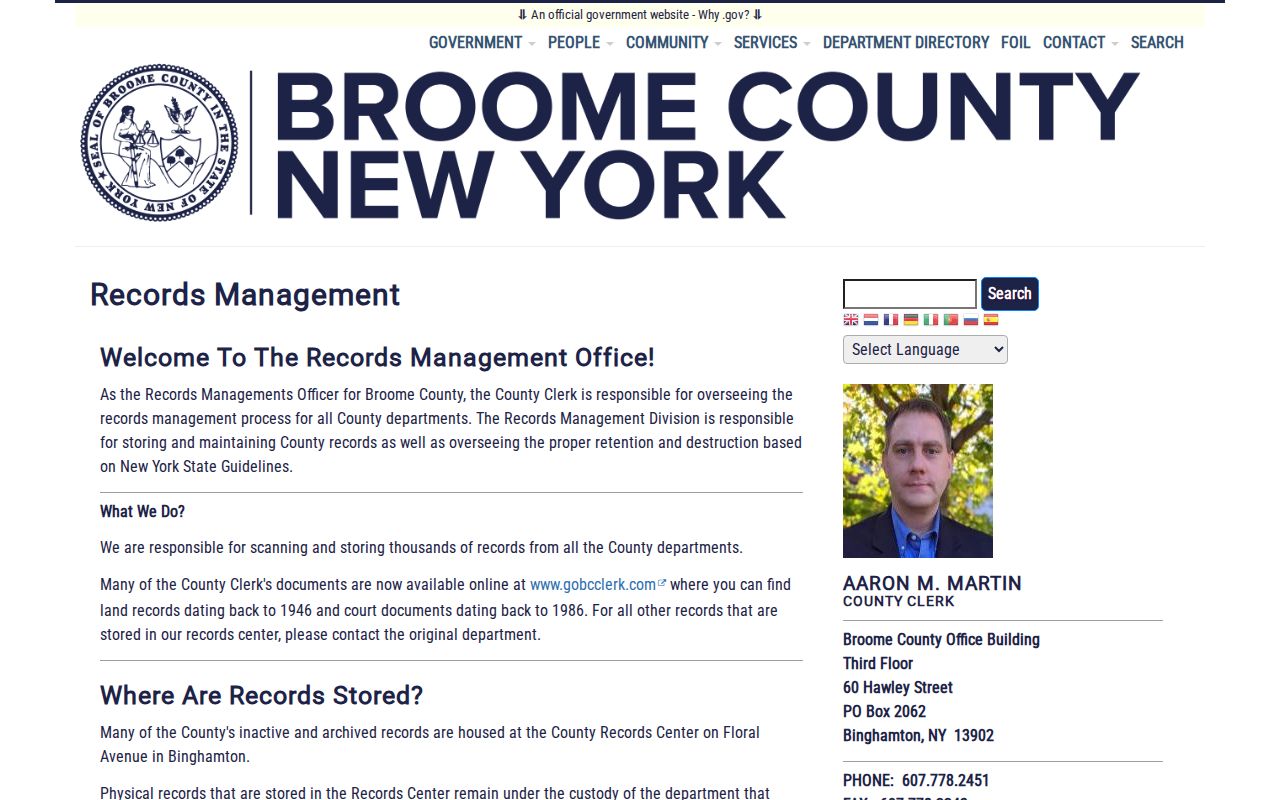
Records Management is the fallback for inactive county material, while the department that created a record remains its custodian. The Clerk charges $.65 per in-person deed page and $1.90 for a home print or download. Request current pricing for other copies and certifications.
| Official source | Useful evidence | Practical limit |
|---|---|---|
| Parcel search | Owner, situs, mailing address, and tax parcel | Not proof of household membership |
| Clerk deed image | Grantor, grantee, recording date, and legal description | Older images or books may be offline |
| Library directory or obituary | Historical address, occupation, relatives, or death clue | Published presence, not continuous residence |
| Commercial data category | May offer a lead requiring independent checking | Can be stale, misattributed, or subscription based |
Binghamton Courts Need Correct Paths
A court search addresses a case question, not a general residency question. Binghamton City Court sits on the fifth floor of City Hall and provides calendars, forms, and certificate-of-disposition instructions. WebCivil Local searches party names, index numbers, attorneys, judges, court locations, and calendar dates. A spelling variant or initial can change the result, so preserve the court and case number with any hit.
Sealed matters, youthful-offender cases, adoptions, portions of Family Court, and cases not yet entered can be absent from eCourts. For a complete file or a certified disposition, contact the court clerk with the party, case type, date, and index number. Court records are generally accessed under Judiciary Law §255 and court rules, rather than through a City Hall FOIL request.
Binghamton Vital Records Have Limits
City Vital Statistics handles births and deaths that occurred within Binghamton’s city limits from 1884 forward. The City Clerk handles marriage licenses issued in the city. A Broome County address is not enough to establish city jurisdiction, so confirm the municipality of the event before sending an application. Current certificates are eligibility controlled and are not available through FOIL.
For genealogy, city and state rules generally open birth records after 75 years when the person is known deceased, death records after 50 years, and marriage records after 50 years when both spouses are known deceased. The city lists $10 eligible certificates and $22 genealogy searches. The New York State genealogy program covers statewide records with its own application, wider-search fees, and extended processing time.
Binghamton Historical Resident Directories
Binghamton’s historical resident directories are strongest when a name or address can be placed in time. The New York State Library reports fiche for 1857 through 1859 or 1860, then film runs for 1869–1880, 1883–1893, 1895–1900, and 1902–1946. NARA adds a 1928–1933 microfilm run. The city directories can show a published address, business, occupation, spouse notation, or street-order entry. They cannot prove ownership or capture every household member.
The Broome County Public Library Local History & Genealogy Center is the local shelf for directories, maps, obituaries, microfilm, and historian collections. The fuller chronology and entry-reading method belongs in the Binghamton city directory collection guide. Pair a directory year with the nearest census, deed, obituary, or probate file to avoid mistaking a publication gap for a move.
- Roll
- A record list created for one official purpose, such as assessment or voter registration.
- Index
- A searchable pointer to a record, not always the record image itself.
- Criss-cross directory
- A historical address-to-occupant listing, sometimes called a reverse directory.
- Parcel
- A tax-map unit tied to property boundaries and a parcel identifier.
Binghamton Library Record Story
Binghamton has an unusually concentrated local-history route. The Local History & Genealogy Center on the second floor of the Broome County Public Library combines public-library collections with Broome County Historical Society, county historian, and city historian material. Its holdings include printed histories, maps, photographs, vertical files, obituaries, and newspaper microfilm. Two public computers are available for research.
Hours vary by day, with Monday, Wednesday, Thursday, and Friday split between 10:00 a.m.–1:00 p.m. and 2:00–4:00 p.m., plus Tuesday afternoon and evening hours. Confirm before a trip. Remote paths are concrete: an obituary-file copy is $2, while a pre-1960 or unavailable-file microfilm search costs $10 per hour plus $.25 per copy, prepaid. The library does not fax or email obituary requests, and general research is also billed at $10 per hour.
The practical value is not just the shelves. Local newspapers were not topic-indexed on the reels, so a date and name matter. Library staff, the county historian, and the city historian can help route a question to a directory, obituary file, map, city record, or the correct archival collection.
Binghamton Records From 1806 Onward
Broome County’s records story is a set of useful numbers, not a promise that every document is online. The County Clerk describes records dating to 1806. Its principal page identifies online land records from 1935, while the Records Management page says 1946. The deed instructions describe downloadable deeds from 1963. Court documents are advertised from 1986. A result can therefore exist in the index even when the image or a prior link must be found at the counter.
That distributed history explains why a Binghamton residents directory search sometimes turns into a library-film or records-center request. The county scans and stores thousands of records but leaves custody with the department that created them. Ask for an older document by date, department, book and page, parcel, or case number. Specific requests reduce the risk of asking a custodian to create a new compilation.
The Clerk’s free Property Fraud Alert can send an email when a deed or mortgage is recorded under a subscribed name. The county cautions that people can share a name, so inspect the document and match the property before acting.
Binghamton Registry and Custody Checks
The official New York sex offender registry subdirectory is a status-specific public record, not a broad resident search. Its online form searches by one mode at a time: last name, county, or ZIP. A CAPTCHA applies, and online results are limited to Level 2 and Level 3 public registrations. Identity and current status must be checked against the state’s record.
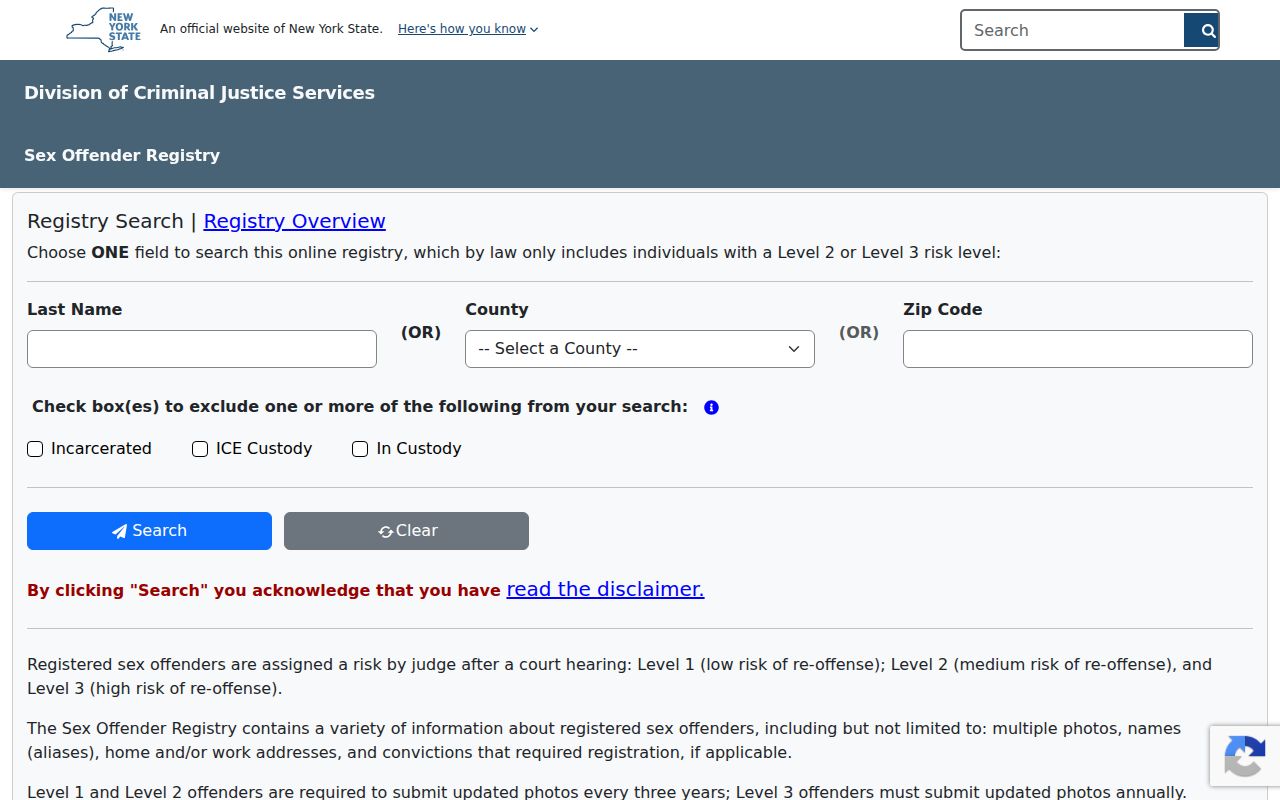
Broome County’s Corrections Division did not have a public web roster in the official sources inspected. Jail inquiries go through Sheriff dispatch, while releasable local records may require a records request. A registry match or custody inquiry should not be treated as a general criminal history or as evidence about anyone sharing a name.
Lawful Binghamton Record Use
New York FOIL, Public Officers Law Article 6, §§84–90, is the route for reasonably described existing agency records. A City of Binghamton request goes to the City Clerk and Records Access Officer, who says the city responds within five business days. Describe the department, address or subject, date range, and record sought. FOIL does not require an agency to build a new list from scattered files.
Personal privacy exemptions, confidential voter registration, the Address Confidentiality Program, restricted vital records, and sealed court material remain important limits. Public records are appropriate for personal, family-history, property, civic, and safety questions when used responsibly. Never use a record to stalk, harass, intimidate, expose protected information, or evade a confidentiality program.