
Trace Binghamton Previous Residents by Era
Past residents require evidence that is close to the target year. A current parcel detail anchors the property. Recorded deeds establish a chain of legal owners. Directories and telephone books may place a named person at an address. Census schedules describe households at a particular enumeration. Maps, permits, obituaries, and probate files answer different parts of the same question. The dates below are coverage descriptions from the relevant Binghamton and Broome sources, not a promise that every item is online or indexed.
| Historical source | Period described | Holding or route | Best evidence supplied |
|---|---|---|---|
| County Clerk land records | Records reach to 1806; online descriptions use 1935, 1946, and 1963 milestones | GoBCClerk, Clerk counter, Records Center, or older books | Legal owners, mortgages, liens, grantor/grantee, and legal description |
| Binghamton city directories | Fiche 1857–1859/60; film 1869–1880, 1883–1893, 1895–1900, and 1902–1946 | NY State Library, BCPL, NARA, and some licensed or digitized collections | Address association, occupation or business, and household notation |
| Telephone books | 1922–1923 and 1935–1942 in the stated NYSL holdings | New York State Library film | Listed subscriber name and address, with omissions possible |
| Federal census schedules | 1790–1950, subject to the 72-year public-release rule | NARA, library services, and research collections | Household members, ages, relationships, and address context |
| Sanborn maps | 1887, with 1891 and 1901 items located | Library of Congress map collection | Building footprint, construction, use, and nearby streets |
| Permit and code records | Exact public run not located | Binghamton Building and Code Enforcement by request | Construction, alteration, demolition, or inspection evidence when releasable |
| Obituary and probate sources | Local files and estate records, including pre-1960 newspaper microfilm path | BCPL Local History Center and Broome Surrogate's Court | Death, relatives, estate transfer, executor, and address leads |
Start with the source nearest the date you need, then work both backward and forward. A directory entry shows presence when the volume was prepared. A deed shows a legal transaction. Neither automatically proves the full household for every year.
Anchor Binghamton Past Residents to a Parcel
Broome Image Mate is the best present-day starting point for previous residents research. Enter the number and street, then save the parcel ID, situs address, municipality, owner of record, mailing address, and available tax-map or legal-description details. The system accepts partial address searches, so a street-only result can help find a parcel when the number is uncertain.
The parcel card has limits. Its owner mailing address can be elsewhere, and an owner name is not a list of occupants. Its value is that it fixes the tax-map unit before an old deed, address, or directory page is matched to the wrong property. Use the municipality as well as the Binghamton postal text, since neighboring towns can share that postal city.
Walk the Broome Deed Chain Backward
Legal ownership is traced from the current parcel into the Broome County Clerk's GoBCClerk index. The Clerk's FAQ says to choose Search Records as Guest, enter a party in Party 1 as LAST FIRST, and search. When the book and page are known, the book needs a D prefix, such as D1234. The initial View screen is the recording page, then blue arrows move to the deed image.
- Use Image Mate to record the current owner, parcel ID, and legal-description clues for the Binghamton address.
- Search the current owner as Party 1 in the Clerk index, open candidate instruments, and match the legal description and recording date to the parcel.
- Identify the grantor, the person or entity conveying the property, and the grantee, the person or entity receiving it, in the matched deed.
- Search the earlier seller as a grantee to find that party's prior acquisition. Continue backward one verified transfer at a time.
- When a deed conveys several lots or a subdivision, follow the legal description and recorded plat instead of relying only on the current house number.
- For records that do not appear online, ask the Clerk, Records Center, or originating department about counter books, film, and copy access.
Note each link's book or page, recording date, parties, legal description, and whether the document actually names the address. Mortgages, liens, estate conveyances, and restrictions can clarify why a transfer happened, but should not be used to infer personal facts outside the record.
Binghamton Deed Terms for House History
The Clerk index offers leads, but these terms are read from the recorded document. They keep an address history tied to the actual land interest rather than to a name that may recur in Binghamton.
- Grantor
- The person or entity that conveys an interest in the property through a deed or related instrument.
- Grantee
- The person or entity that receives the interest. Searching an earlier grantor as a grantee is a common way to find the preceding acquisition.
- Chain of title
- The documented sequence of conveyances and related records that connects one owner to earlier legal owners.
- Legal description
- The lot, block, subdivision, metes-and-bounds, or other land description in a deed. It is more dependable than a street number when addresses change or repeat.
A recording date is not always the same as the date the deed was signed. Read the image before placing a transfer into a chronology of previous residents.
Keep Binghamton's Deed Milestones Separate
The County Clerk page describes land records online back to 1935. Records Management says Clerk land records reach back to 1946. The deed FAQ says deeds dating to 1963 are downloadable. They are not conflicting instructions to resolve by picking one year. They describe different practical points in search, index, image, or download access.
The county says its broader Clerk record trail reaches to 1806. An older Binghamton house may therefore have a chain that begins online but continues into counter material, records-center custody, books, or film. Keep the date and access channel beside every citation. It makes gaps visible and avoids overstating what a digital result proves.
Pair Binghamton Directories With Census Years
Directories and census schedules provide the household layer that deeds do not. Binghamton's local holdings have real gaps, so use nearby available years instead of assuming a missing directory means the family left. The NY State Library lists fiche for 1857–1859/60 and film runs beginning in 1869, while NARA has separate Binghamton microfilm for 1928–1933. The 1950 census is the newest fully public decennial release identified in the research.
- Find a directory or street-order page near the census year and write down the exact spelling, initials, address, and any household notation.
- Check the name section and the reverse or street section, because a person can appear under an initial, a spouse, or a business address.
- Compare the closest directory years on each side of the target date. The NYSL stated run has gaps including 1881–1882, 1894, 1901, and the years after 1946.
- Use the census to test the address context and household composition, while remembering the directory may have been collected months before it was published.
- Use an obituary, probate file, later deed, or newspaper lead to explain a death, estate transfer, or move suggested by the sequence.
The collection details and entry-reading conventions belong on the Binghamton city directory page. For a previous-resident search, record only the dated address link needed to bridge the house timeline.
Use Binghamton House-History Leads
West Side Neighborhood Association resources include property-research material, a city council district map, and Housestories chapters. They offer useful Binghamton neighborhood context, especially for a property on the West Side, but they are not an official countywide house-history index or a public household roster.
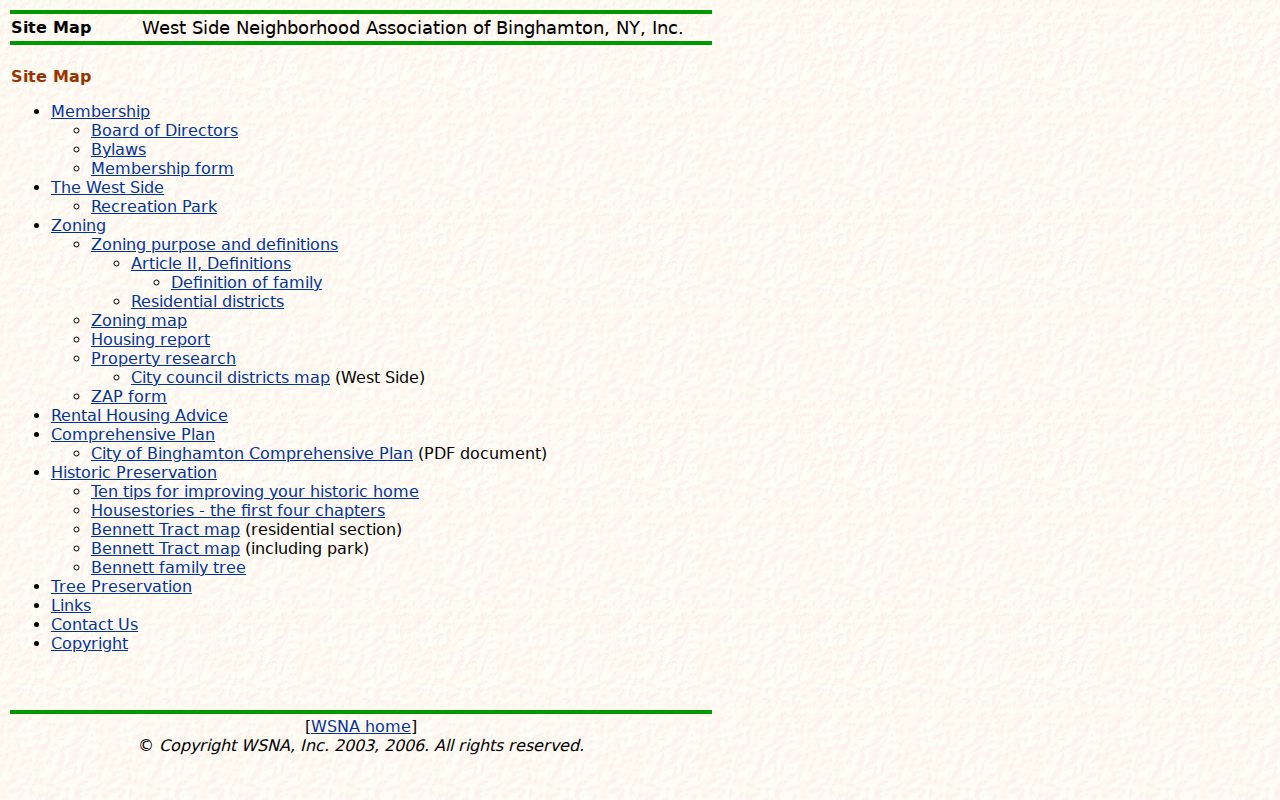
The association's property and house-story material can help frame a parcel in its neighborhood, then deeds, maps, and directory entries provide the dated evidence for previous residents.
The Broome County Public Library Local History & Genealogy Center is the main mixed local fallback. It brings together city directories, maps, obituaries, vertical files, photos, county and city historian resources, and historical-society material at 185 Court Street. Paid research and its documented obituary and microfilm routes may help when a needed item is not online.
Test Binghamton Address Continuity
The Library of Congress has a Binghamton Sanborn set for 1887 with 19 sheets, along with located 1891 and 1901 map items. Locate the street, sheet, block, and nearby landmarks, then compare map editions and the parcel's legal description. Sanborn maps establish structure and setting, not the names of people who lived there.
No authoritative source inspected supplied a Binghamton-wide residential street-renumbering year. Do not invent one. If a number is uncertain, bridge the address with directory street order, cross streets, Sanborn landmarks, city traffic-code street names, tax-map lots, deeds, and a city historian inquiry. Search City of Binghamton and nearby town jurisdictions when the postal city alone is ambiguous.
Building Construction and Code Enforcement may also hold address-specific alteration, demolition, or inspection evidence. No public searchable database was found in the research. Request an existing file by address, permit type or number, date range, and desired fields through the department or a focused FOIL request.
Close Binghamton Resident Trails Carefully
An obituary or probate file can explain the endpoint of an address history. The Broome County Public Library keeps local obituary resources, although pre-1960 newspaper work can require a microfilm search. Broome Surrogate's Court estate files may identify a decedent, executor, heirs, notices, and estate information, while sealed or confidential portions require court authorization.
These sources can turn a property transfer into a documented estate event, but they do not permit broad conclusions about living relatives or all members of a home. For a copy or file search, contact the court clerk with the name, approximate date, and available case information, and ask about current access requirements.
Protect Binghamton Previous Residents
House-history research is strongest when it is narrow and dated. Current vital records have access restrictions. DMV addresses, utility customer data, confidential voter records, and actual Address Confidentiality Program locations are not public address-history material. A blank result does not prove that someone did not live at a property, and a historic entry should not be turned into a current personal profile.
Personal, lawful use. Use a Binghamton previous-residents trail for family history, estate research, property history, or personal curiosity. Never use an address record to stalk, threaten, intimidate, or harass a living person.
Keep document copies private when they contain sensitive identifiers. New York's FOIL, Public Officers Law Article 6, §§84–90, applies to qualifying government records but preserves privacy and statutory exemptions. For a protected record or removal question, contact the public-record custodian that holds it.