
Binghamton City Directory Holdings
The Binghamton city directory record is broad, but it is not one uninterrupted online run. The New York State Library reports fiche for 1857 through 1859/60 and film for 1869 through 1880, 1883 through 1893, 1895 through 1900, and 1902 through 1946. Broome County Public Library's Local History & Genealogy Center is the practical local starting point for directories, maps, obituary files, and referrals. NARA also lists Binghamton 1928 through 1933 on city-directory microfilm. Confirm a particular year before travel or requesting a reel.
| Collection | Years | Where Held | Access |
|---|---|---|---|
| Binghamton city directories | 1857-1859/60 fiche; 1869-1880, 1883-1893, 1895-1900, 1902-1946 film | New York State Library Genealogy room and film | In-person research; confirm catalog and film availability |
| Binghamton directory images | 1883, 1885-1893, 1896, 1899-1911, 1926-1939, plus other years | U.S. City Directories and licensed or digitized collections | Library Ancestry Library Edition or access that varies by collection |
| Binghamton microfilm | 1928-1933 | National Archives | NARA copy route or interlibrary request |
| Telephone books | 1922-1923 and 1935-1942 | New York State Library film | Reference and film access |
| Rural Directory of Broome County | 1894, second part digitized | New York Genealogical and Biographical Society collection | OCR search or browse, with incomplete-volume caveat |
Gaps matter. The stated state-library film run does not include 1881-1882, 1894, 1901, or years after 1946. A gap is not evidence that a household moved. It may only be a gap in the available run or a volume not yet located.
Binghamton Historical Directory Desk
The Broome County Public Library Local History & Genealogy Center is on the second floor at 185 Court Street. It brings together public-library materials with county historian, city historian, and historical-society holdings. Two public computers, printed histories, photographs, maps, vertical files, newspaper microfilm, and obituary indexes make it more useful than a directory shelf alone. Its published hours divide several days into morning and afternoon blocks, so check the current schedule before visiting.
The Local History & Genealogy Center identifies the local access channels behind this Binghamton historical-directory research.
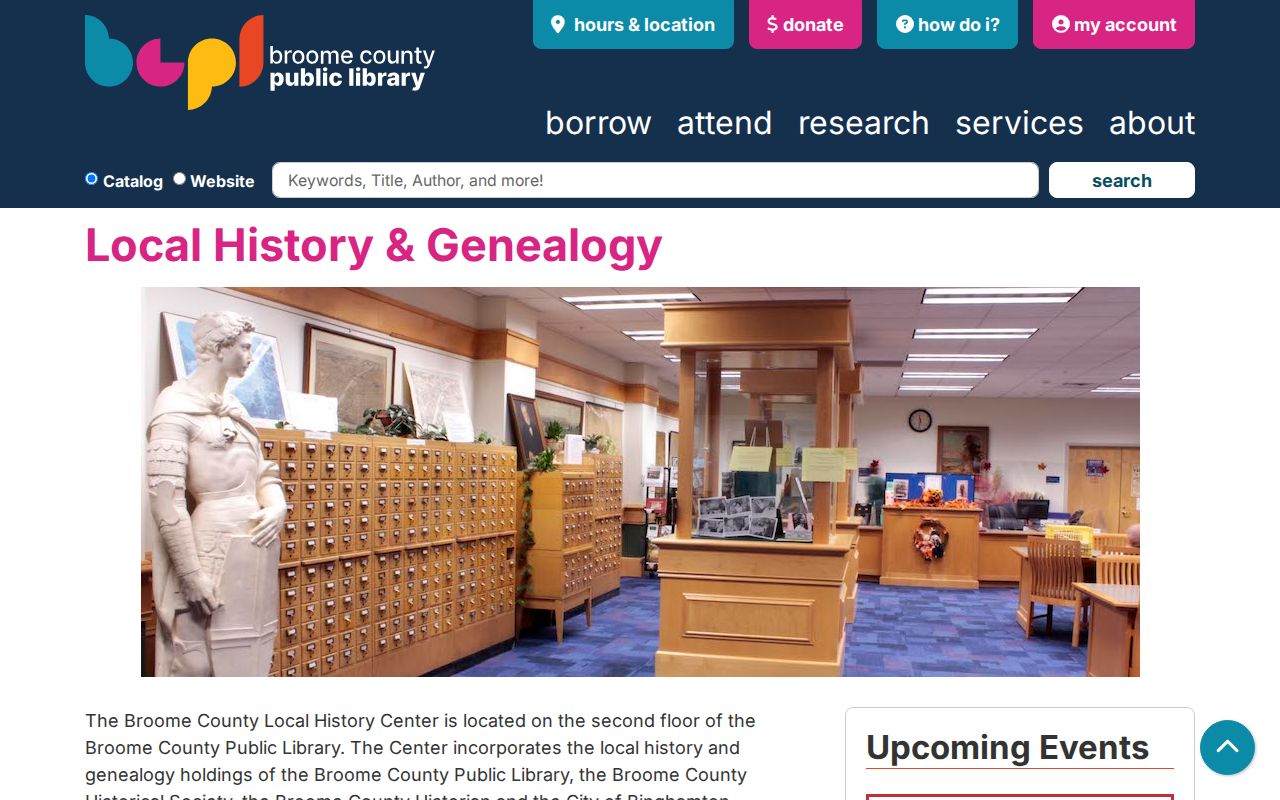
For remote work, the center documents prepaid general research at $10 per hour, $2 obituary-file copies, and pre-1960 or unavailable-file microfilm searching at $10 per hour plus $.25 per copy. Obituary requests are mail-only, require identifying details and a self-addressed stamped envelope, and are limited to out-of-area residents. Newspaper reels are page images rather than a local topic index.
Binghamton Directory Companions Online
Digitized sources fill some Binghamton directory gaps without pretending to replace the original books. The NYG&B Broome histories and directories collection provides a searchable 1885 history, the partly digitized 1894 rural directory, and a 1924 family and personal-history volume. Its OCR is a finding aid. Names, initials, and street spellings should be checked against the displayed image.
The New York State Library city-directory holdings remain important for the film and fiche sequence, while the 1900 Binghamton history and biography at the Library of Congress offers a free digitized volume with 1,035 pages and 1,150 images. Those histories supply biographical and civic context, not a complete household list. Binghamton University Special Collections adds open local-history manuscripts and ephemera dated 1850 through 2025.
Reading Binghamton Directory Entries
A Binghamton directory page may be an alphabetical name list, a business classification, or a dense street-order index. The inspected 1930 sample shows street names, house numbers, cross-street context, and resident names in compact columns. Begin with the exact page image. An entry may use an initial, shortened given name, spouse notation, or an occupation abbreviation, so a search should include surname variants and the street when known.
| Name | Surname, given name or initial, and sometimes spouse or household notation |
|---|---|
| Address | Street number and street name; street-order pages work from address to occupant |
| Occupation | Occupation or employer abbreviations may appear in the name section |
| Business detail | A business can have its own address or classification rather than a residence |
| Household notation | Marks such as “h,” “r,” “wid.,” or parenthetical spouse references must be checked against that volume's key |
- Criss-cross directory
- A reverse or street-order section that starts with an address and identifies the listed occupant or business.
- Householder index
- A name-based portion intended to locate a household listing, though its coverage can differ from the street section.
- Abbreviation key
- The volume's own explanation of short forms. Photograph or note it before interpreting “h,” “r,” “wid.,” or an occupation code.
Do not turn a historical mark into a conclusion. The research identifies common forms, but the key in the physical or digitized Binghamton volume controls their meaning. Likewise, a listing shows presence at publication time, not legal ownership or every resident of a home.
Binghamton Directories by Address
The reverse side of city-directory research begins with the address. A street-order entry can place a listed occupant beside house numbers and cross streets, making it useful for a block-level historical question. It is a different tool from Broome's modern parcel record: the older book reports a published listing, while the parcel card identifies current assessment and owner-of-record information. For the current, address-keyed chain, use the Binghamton street directory after the historical address is narrowed.
Street pages can be especially helpful when a surname has several spellings or when the alphabetic section gives only an initial. Compare adjacent house numbers, cross streets, the directory's compilation date, and maps. The 1887 Binghamton Sanborn set has 19 sheets at the Library of Congress and can establish the building footprint and nearby landmarks. It does not identify occupants.
Binghamton Historical Society Sources
The Binghamton directory trail is stronger when the published volumes are paired with the historical collections held through the local center. Broome County Historical Society, the county historian, and the city historian contribute photographs, artifacts, oral-history context, and local reference material. Those holdings can explain a neighborhood, an institution, or an older street reference that a directory leaves unexplained.
Broome County Historical Society is one of the local sources associated with Binghamton historical research.
For a death or move, BCPL obituary files and the Binghamton Press or Evening Press microfilm can supply dates and relatives. The papers are not locally topic-indexed, so a surname and date range make a request more workable. An obituary is a lead to probate, cemetery, or a later address, not a substitute for the underlying record.
Binghamton Directory Run Timeline
The collection sequence has useful landmarks. It shows why a Binghamton search often moves among shelves, film, digitized text, and archives instead of relying on one catalog.
- 1857-1859/60: Binghamton directories are reported on New York State Library fiche.
- 1869-1880: The reported film run resumes.
- 1883-1893: Another stated film sequence supports late nineteenth-century household tracing.
- 1895-1900: The state-library sequence returns after the 1894 gap.
- 1902-1946: The reported film run continues, with NARA providing a separate 1928-1933 microfilm fallback.
The break after 1946 is a collection statement, not proof that all publishing ceased or that no later directories exist elsewhere. Telephone books for 1922-1923 and 1935-1942 supply a narrower companion source. Check title pages and catalogs when a year falls near a gap.
Trace Families in Binghamton Directories
Use a Binghamton directory as one dated observation in a household timeline. Pair it with a census closest to the volume, then test each address change with newspapers, deeds, probate, and map evidence. Federal census schedules through 1950 are public under the 72-year release rule. A directory may have been compiled months before publication, so it can reflect a prior move.
- Find the closest available directory year for the known name or address and record the spelling, street number, occupation, and every household mark.
- Check both the alphabetical and street or criss-cross portions, because a person may appear under an initial, spouse, or business listing.
- Compare adjacent available years, allowing for the stated gaps before treating an absence as a move.
- Pair the directory date with the nearest federal census to test household members, ages, relationships, birthplace, and address context.
- Use newspapers and obituaries for a move or death, probate for an estate or heirs, deeds for ownership, and Sanborn maps for the structure.
A disappearance has several ordinary explanations: a move, death, listing under another spelling, a business-only address, or a missing volume. A modern record may help verify a later connection, but it should not be assumed to identify a historical person with the same name. Note: A Binghamton directory listing is evidence to compare, not final proof of residence, ownership, or family relationship.
Binghamton Directory Research Limits
Historical volumes should be read with their limits in view. They can omit unlisted people, list a workplace or boarding address, use old names, and contain OCR errors. Postal Binghamton also crosses municipal boundaries, so an address should be checked against its parcel municipality before connecting it to city records. The City of Binghamton, Town of Binghamton, Chenango, Dickinson, Union, and Vestal can share the same postal city text.
When a reel or online image does not answer the question, the documented fallback path is BCPL, the New York State Library, NARA, Binghamton University Special Collections, the county or city historian, and the originating records office. The university's Local History Manuscripts and Ephemera collection, identified as BUSC-2025-001, dates from 1850 through 2025 and is open for research with no known restrictions. The 1900 biography and the 1885, 1894, and 1924 Broome volumes preserve different kinds of names, so their indexes should be searched beside, rather than in place of, a dated directory volume. That layered custody is a local strength. It also means a careful search records where each fact came from and avoids filling gaps with assumptions.